

What To Expect From This Article
- Consumers are increasingly turning to AI answer engines to help them make their purchasing decisions. They received curated recommendations on what brands to buy, choose, and trust.
- AI learns from ecosystems, pulling from social, creator, and user-generated content.
- There is no singular platform that AI pulls from. It learns from different platforms across the web.
- Independent voices (such as that from reviews, tutorials, etc) are shaping the information that AI uses to understand brands.
- AI incorporates new information quickly, so brands need to push out new content every day to be featured in its ever evolving learning and recommendations.
- Brands must build attention for both attention and recommendation, and need to start ASAP while the recommendation era is in early development.
Brands are not just marketing to humans anymore.
Today, people are turning to AI for literally everything and that includes their shopping habits. One of AI’s biggest shifts is how it’s become a go-to, virtual shopping assistant, consolidating information to help consumers determine what to ‘Add to Cart.’
Instead of navigating through pages of links and reviews, they’re receiving synthesized answers, curated recommendations, and increasingly, direct suggestions about what brands to buy, trust, and choose. As AI becomes more and more prevalent in our day to day routines, and shapes our buying and spending, an important question is on the top of every marketers mind:
What does AI trust enough to recommend?
And the underlying question…how do I make sure my brand, or my products, are the ones being recommended?
We teamed up with Profound to get the data to better understand how exactly AI recommendations work.
Here’s your AI AEO crash course AKA the key to winning brand discovery in the recommendation era.
Where Do AI Answer Engines Pull Brand Information From?
One of the most important things we’ve learned from our study is where AI pulls information from. What stood out most was the rate at which social, creator, and user-generated content has climbed as a source. Over the last six months it rose as a share of citations across five of the six major AI engines we studied. It is one of the fastest-growing inputs shaping how AI understands brands. Although the platforms varied, it became clear that social content is a huge contributor to AI citations.
However, just having a social media presence does not guarantee visibility. Brands need to be highly intentional and consistent about what they’re posting and where. Volume may be a factor in how AI agents discover your brand, but citation is the overall goal. The brands that are actually making this distinction, and showing up in recommendations, are the ones who have expanded and developed their social scopes. They’re showing up across media, reviews, creator content, community discussions, expert sources, and more. Essentially, they’re tuned into various conversations happening online, giving AI a variety of sources and formats to pull from.
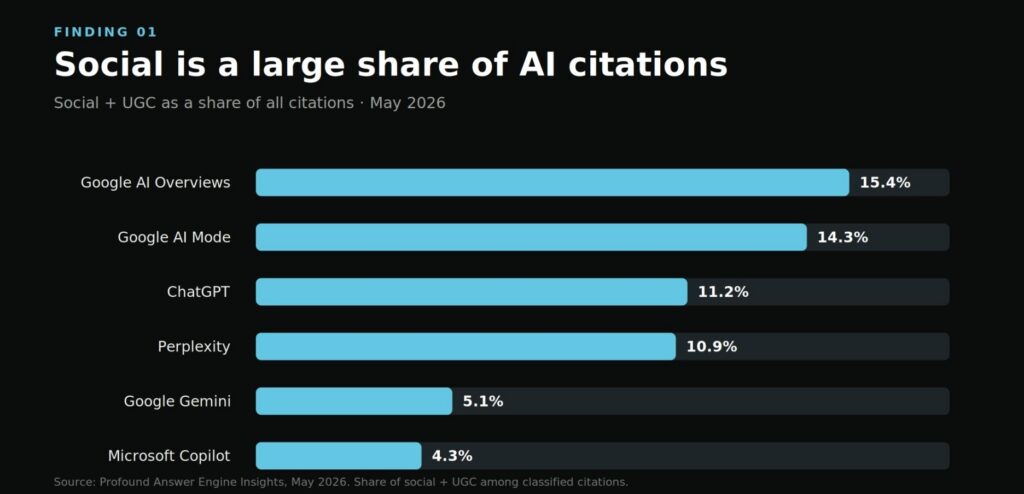
The biggest takeaway here is that social media has increasingly become part of the information pool AI uses to understand brands. A strong social media presence shapes visibility, reference, and familiarity but it also develops credibility and authority, which AI will look for when it responds. So, it’s not necessarily about posting the most, but it is crucial that brands post enough to discover what pieces earn independent citation, so they can analyze and scale it across the web.
Which Social Platforms Drive the Most AI Recommendations?
We’ve established that AI learns from ecosystems…but exactly which ones? Well there’s bad news and good news. Bad news first: There is no one ecosystem, or singular AI strategy that brands can implement for visibility. The good news is that brands are entirely capable of discovering what content of theirs resonates with AI and building a strategy from there.
But first, more of the stats:
Our research shows that:
- Google’s AI products lean heavily on Youtube
- ChatGPT relies more heavily on Reddit
- Copilot draws from distinct professional networks like LinkedIn
We also discovered that among all social platforms, YouTube was the strongest proof point. It’s rapidly climbing across competing answer engines, moving from roughly #247 to #34 in ChatGPT and from #61 to #13 in Copilot. It’s a huge signal for brands to keep track of, but it’s also not the only factor to consider. The ecosystem is still largely complex, so it’s crucial for brands to treat every platform intentionally, and to continue building their understanding to AI. It may be a process, but the brands truly winning in this next era are the ones that understand where influence lives and build accordingly.
Does AI Trust Brand Websites or Creator Videos More?
As noted, YouTube is a huge player in the AI visibility game, and there’s a reason for that. As AI systems look for trustworthy, explanatory content, it’s often being pulled towards creator-led videos, AKA exactly the kind you’d find on YouTube!
AI is not swayed by branding or messaging. Instead, it disproportionately favors content that explains, evaluates, and educates.
Think…
- Reviews
- Comparisons
- Tutorials
- How-to content
- & Creator-led recommendations
AI is single-handedly changing the way credibility is built and it’s doing it by spotlighting individual voices. Brand visibility is becoming a function of consistent participation. It is not enough to show up. Brands need to be talked about, referenced, and reviewed across a diverse mix of sources. With creators in the mix, brands earn the third-party validation AI increasingly relies on to recommend them.
How Fast Does AI Index New Content?
AI may have a lot of information to read through, but it certainly doesn’t stall. From publication to citation, the median time it takes for AI to pick up fresh content is just 6.8 days. Ninety percent of content gets cited within about 37 days. Here is the part most brands miss: half of everything AI cites is less than 13 weeks old. That window slides forward every day, so the content working for you now ages out of it. If you are not publishing consistently, you fall out of the answer.
AI is reading the internet continuously (just like us!) so the more information it obtains, the smarter it grows and the more developed its answers will become. New content is at the forefront of discovery, and fresh information is what will shape the future of brand visibility. For marketers, this may come with a bit of a learning curve. A lot of brands still operate on campaign timelines…but the reality is that AI does not. It’s going to reward the brands that show up every day, not every quarter. Consistent publishing, rapid learning, and editorial velocity are going to become some of the biggest advantages.
What Should Be Next Steps for AI Brand Visibility?
If there’s anything to take away, it’s this: brands must build for both attention and recommendation.
- Brands first need to win social and UGC to generate the convos and signals that will put them into consideration.
- From there, it’s all about converting that momentum into authority, across channels, that AI will gravitate to.
We believe that the next 12-18 months of AI discovery will be some of the most important. The recommendation era is still in its early stages, so if brands start now, while systems are still in early development, they’ll show up bigger and better than those who decide to wait. The brands investing in their content footprint now are teaching AI what to recommend later…don’t wait!
Still have questions on where to get started? Check out the full, completely free report here or contact us – let’s chat!